The Triune (also known as the Cult of the Three[1] Cult of the Triune,[2] or Temple of the Triune) was a cult that existed during the time of the Sin War. Whilst outwardly a benevolent religious body, in reality, it was formed by the Prime Evils as part of their plan to corrupt humanity and convert them to their side.
At some point after Malthael's fall, the group re-emerged.
Lore
The evil that permeates the Triune consumes, ending in violence and death.[3]
Organization
- Transcript of a sacrifice ritual within the Triune(src)
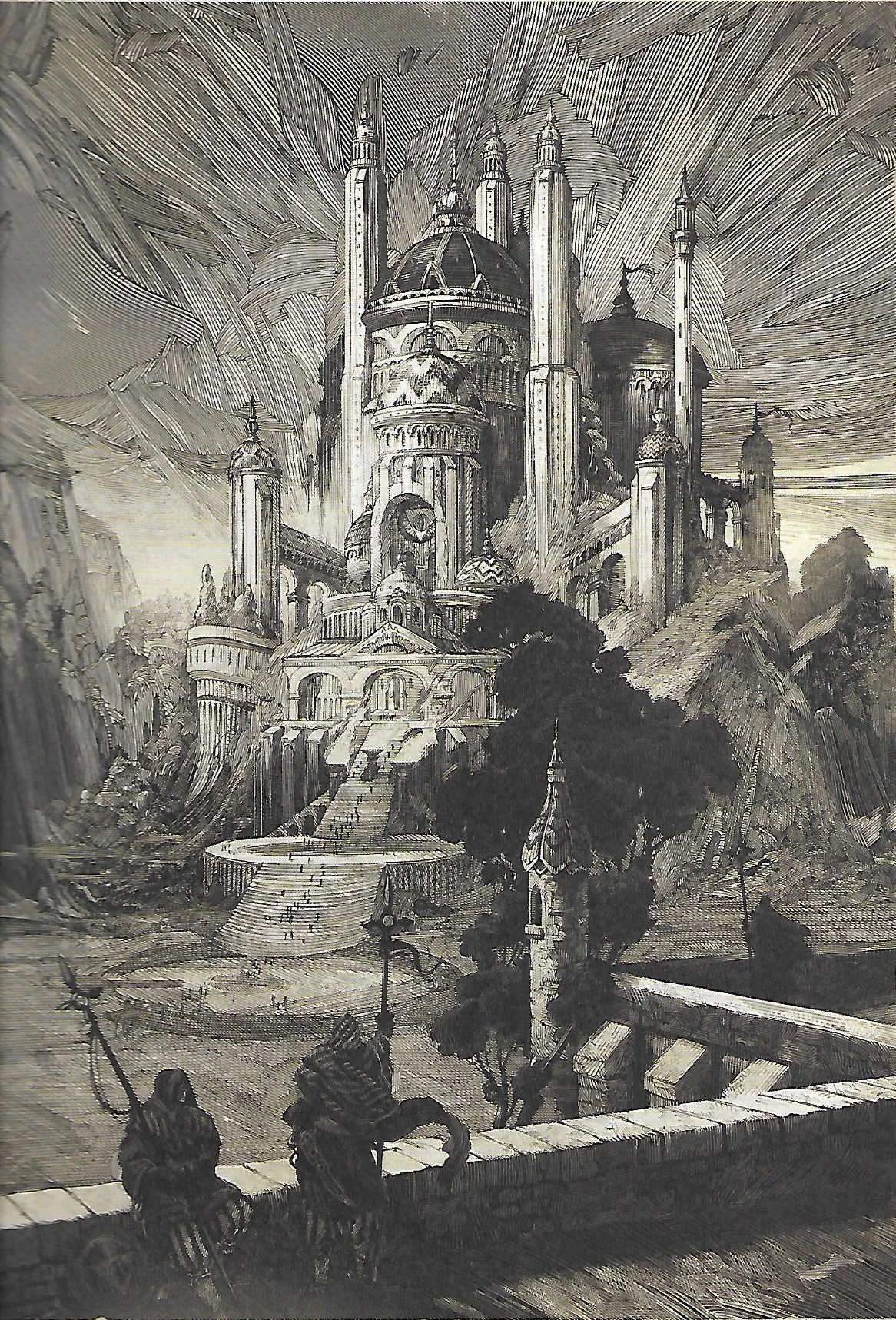
The Grand Temple
The Cult of the Triune was composed of primarily by the swarthy natives of Toraja.[4] The Triune's message to the populace was that through selfless worship and devotion, one could improve their lot in life.[1] It likewise preached peaceful resolution to conflicts. Unlike the Cathedral of Light, it championed the individual, rather than the whole.[5] The number three was sacred to the Triune—it is said that the number was represented in the cult's own architecture, mirroring its three deities, and even its Peace Warders always traveled in threes.[1]
The Triune had temples in various major settlements, mainly in the eastern regions of Sanctuary. Each temple was subordinate to the main temple near Kehjan.
The Triune consisted of three smaller cults, each devoted to one of the Triune's three guiding spirits, which were in truth the alter egos of the three Prime Evils. All three cults were lead by a High Priest from the main temple. Other, lesser temples were generally led by a cleric, beneath which were lesser priests that administered each separate branch of the faith.[4] or a band of lesser priests. The governing authority and leader of the Triune was the Grand Priest - the Primus. Peace Warders, cowled guards who wore the symbols of each order on their chests guided newcomers to a cult of their choosing. The demonic morlu served as an elite fighting force, only deployed in special circumstances.
The three guiding spirits were named after the Prime Evils themselves, and were titled with exact opposite of the aspects of the Prime Evils. Unsuspecting initiates were lured into the cults, fooled by the seemingly kind guiding spirits. Gradually their hearts would darken as they were initiated into the true teachings of the Triune, and the true spirits they served. The three guiding spirits were known as Dialon, Bala and Mefis, and each had their associated order. Acolytes of the Triune traveled together, preaching "the Way of the Three."[5] The acolytes could be identified by their style of robes.[6]
Those who knew the true nature of the Primes carried out human sacrifice in their honor.[7]
Order of Dialon
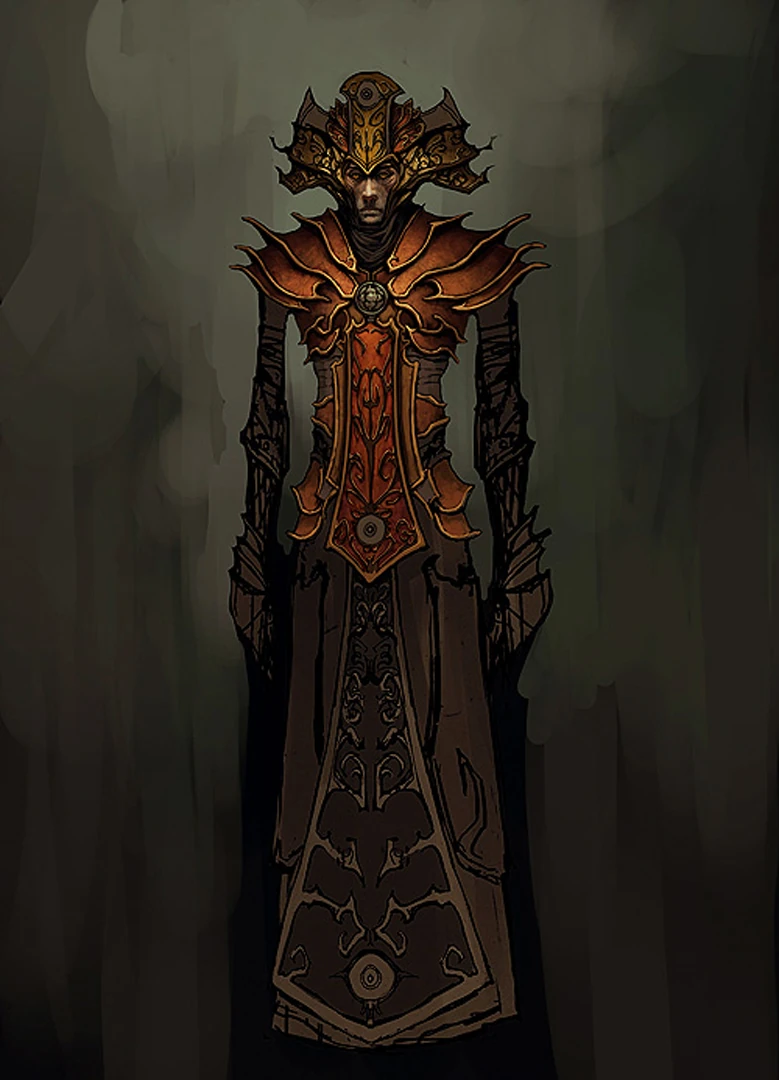
A member of the Triune
Dialon, Spirit of Determination, was represented by a stubborn ram. Dialon was believed to bring purpose to humanity. Statues of Dialon were usually depicted wearing the Tablets of Order, which taught how to achieve blessedness. In truth, followers of Dialon served the Prime Evil, Diablo, the Lord of Terror.[5]
Order of Bala
Bala, Spirit of Creation, was represented by a leaf. Bala preached the blessings of nature and the architectural triumphs of humanity. Statues of Bala were usually depicted wearing a hammer and a bag, which presumably contained the seeds of Life. In truth, followers of Bala served the Prime Evil, Baal, the Lord of Destruction.[5]
Order of Mefis
Mefis, Spirit of Love, was represented by a red circle, the Kehjani symbol for the heart. In a sense Mefis was the most crucial of all spirits, as the Primus taught that Creation and Determination could not thrive without Love. Statues of Mefis were depicted with empty, cupped hands, as if they were cradling an infant. In truth, followers of Mefis served the Prime Evil, Mephisto, the Lord of Hatred.[5]
History
Early History
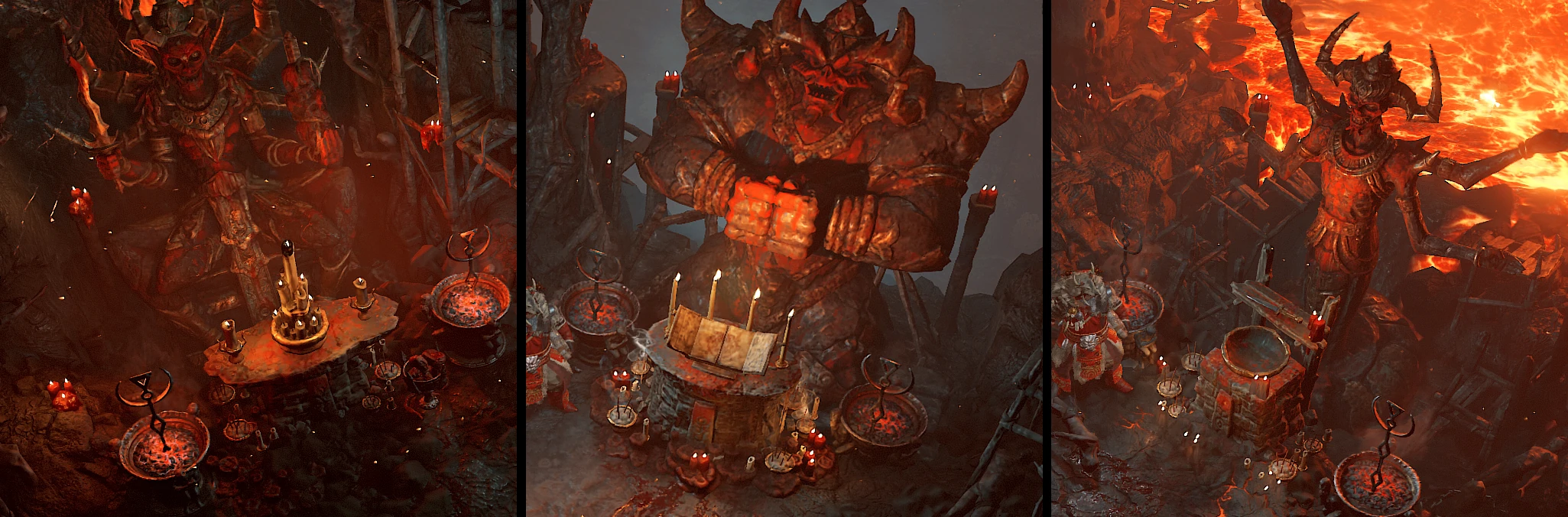
Baal, Diablo and Mephisto shrines erected on Mount Civo
During the Eternal Conflict, which led to the creation of Sanctuary by the hands Lilith, the daughter of the Prime Evil Mephisto, and Inarius, a rogue angel from the High Heavens, the demonic forces of the Burning Hells noticed the existence of the mortal realm and the Worldstone within it. Seeing the potential of turning the tides of the war, the Prime Evils sought ways to corrupt mankind from behind the scenes and take control.
During this period, Mephisto sent his son Lucion to Sanctuary, where he established the Cult of the Triune in the year -1880, as a front for the Prime Evils to manipulate and enslave humanity through blindsided religion.[1] The Temple intentionally sowed chaos among humanity in order to achieve this aim.[8]
Over the decades, the cult's numbers swelled. When Inarius discovered the truth about the Triune, he sought the means to counter the Prime Evils' influence over Sanctuary. He then formed his own sect, known as the Cathedral of Light, in the year -1820, as a rival religion, in order to compete with the Triune in even grounds and bring humanity to his side.[1] While other faiths had existed before them, the Triune and Cathedral eclipsed them all.[5] Over the next decade, both religions achieved immense influence in Kehjan, and an ideological battle erupted between the two, polarizing Kehjistani society. None knew that this was the beginning of the Sin War.[1] With the Mage Clans on the verge of war themselves, many in Kehjan flocked to one of the two faiths.[5]


Downfall


Triune insignia
In the last days of the Sin War, mankind's nephalem birthright awoke within a number of mortals, due to the machinations of Lilith. She sought to topple both the Triune and Cathedral, and while she was ousted, she inadvertantly gave birth to the Edyrem, the next generation of nephalem who were normal people. Uldyssian ul-Diomed, their leader, awakened the Edyrem's latent nephalem powers, and began a crusade against both organizations. The Triune had to content with the loss of Primus Lucion for a time, but Lilith, disguising herself as her brother, took over the Triune.[5]
The Triune rapidly fell into disarray after the mysterious disappearance of the Primus. The Edyrem cut a bloody path against the Triune over Kehjan, removing their power bases from towns such as Toraja[4] and Istani.[6] In the end, the Triune was utterly destroyed, and their Grand Temple fell. While some lesser temples remained, Uldyssian knew that without the Grand Temple's guidance, their influence would quickly fade.[4] The Edyrem spread across the land, purging whatever remaining influence of the Triune they could find. The Cathedral of Light was quick to exploit the power vacuum the Triune's downfall left.[6]
Fragments
Despite the tumult of the Sin War, the Triune survived, and continued to operate. The cult's remnants eschewed the Triune's formerly benevolent facade and operated in the shadows, preserving their order's secrets, awaiting a sign from the Prime Evils. The Coven formed also as a splinter group of the Triune. It was considered likely by Tyrael that other splinter groups also existed.[1]
The Great Enmity
Following Malthael's defeat by the hands of The Nephalem, a power vacuum developed in Sanctuary. The Triune was among the groups who attempted to fill it.[9] The Triune retained its worship of the Prime Evils and sought to return the Three to Sanctuary.[10] However, this new Triune Cult also apparently began worshipping Lilith, calling her "The Blessed Mother".[11] As best can be seen, there appears to have been a schism among the ranks of the Triune between their patrons. Some cultists completely rejected the Three, instead being completely devoted to Lilith, claiming their power and birthright as "favored children" instead of "servants for uncaring masters".[12] However, The Wanderer later noted that members of the Coven appeared to be worshipping the Prime Evils even while the greater whole of the cult worshipped Lilith.[13]
The Triune established and appropriated temples for worship in Nahantu during this period.[14]
The Age of Hatred
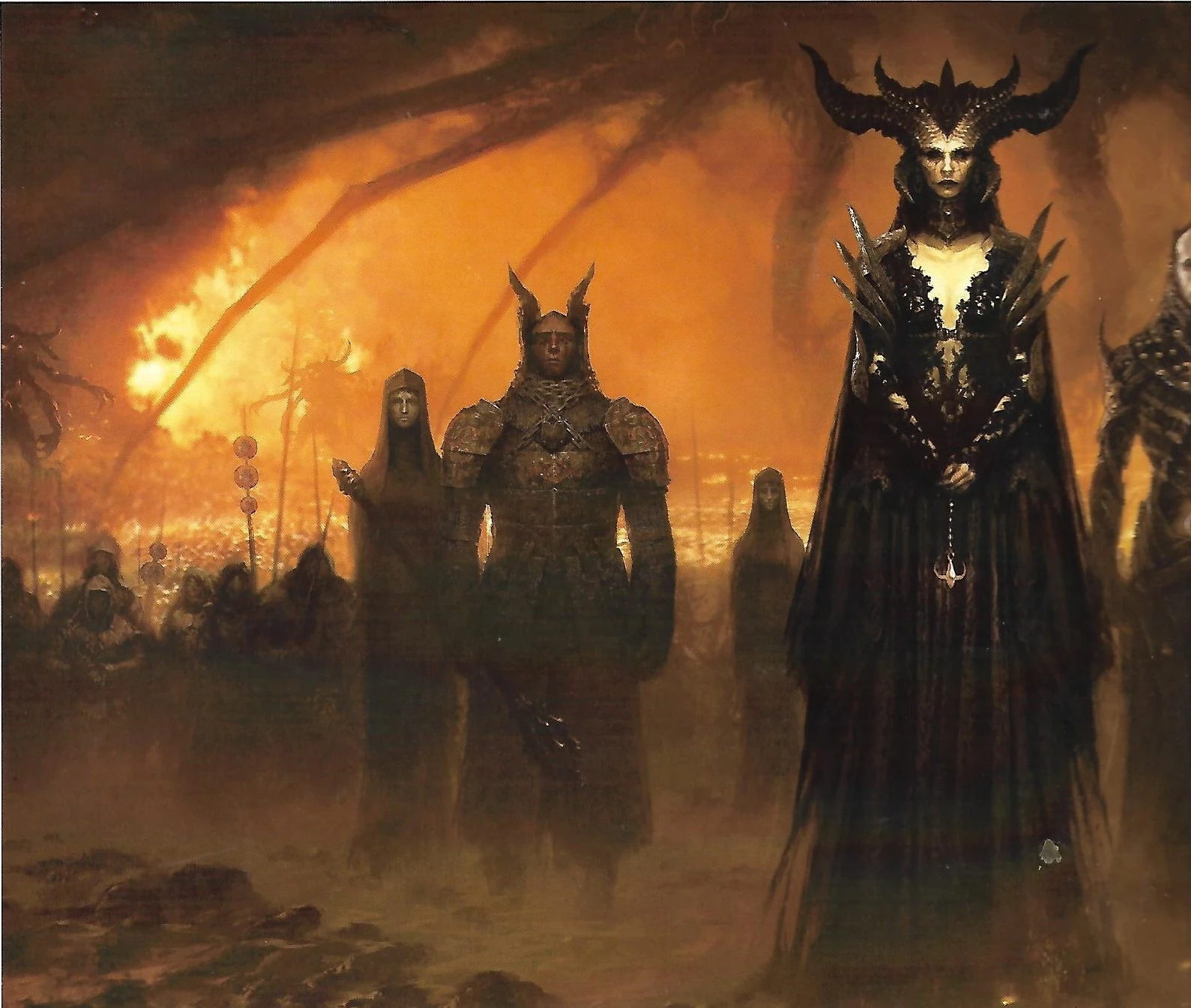

Lilith at the head of a resurgent Triune
In 1336, Elias, a former Horadrim and now a Triune priest, summoned Lilith into Sanctuary.[10] With the return of the daughter of Mephisto, the Triune's members, filled with hatred and drunk on sin, emerged from the shadows.[11] Triune agents integrated themselves into Kehjistani society, spreading paranoia throughout the populace.[10] The Triune also operated in the Fractured Peaks, with the town of Nostrava coming under their sway.[15] The Triune's creed spread across the Peaks, spreading the idea of the strong triumphing over the weak, of worthy individuals no longer suffering at the hands of "lesser" ones.[16]
The Triune marched across the Dry Steppes, shackling unfortunates and bringing them to Mount Civo, where they were slaughtered.[17] Others willingly joined the Triune, as the cult promised an escape from their suffering.[18] The Triune also burnt trading caravans.[19] Triune Assassins were entrusted with finding the perfect candidates for ritual sacrifice and protecting those carrying out powerful summoning.[20]
In-game
Diablo III
Triune cultists appeared in concept art for Diablo III and Reaper of Souls. In the final version of the former game, their position was taken by the Coven (formed from the remnants of the Triune). The following Triune enemies were supposed to appear, many of which have Coven counterparts:
Diablo IV
Triune enemies appear in Diablo IV. Enemy types include the following:
- Dark Summoner
- Mother's Disciple
- Triune Admonisher
- Triune Demoncaller
- Triune Worshipper
Known Members
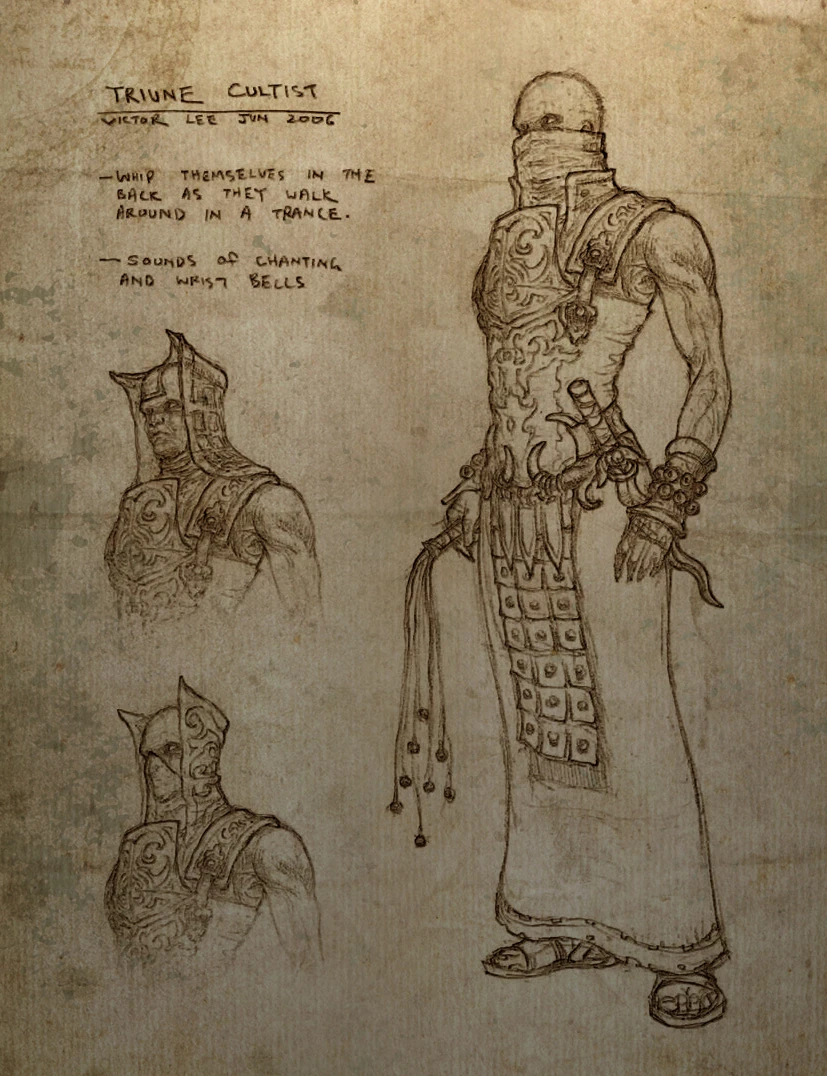

Triune cultist
Sin War
The following members of the Triune were active during the Sin War:
- Primus Lucion (supreme high priest)
- Primus Lilith (usurper of the position)
- High Priest Arihan (head of the Order of Dialon)
- High Priest Balthazar
- High Priest Malic (head of the Order of Mefis)
- High Priest Herodius
- Cleric Ikarion
- Brother Atilus
- Brother Caligio
- Brother Durram
- Cultist Vess
- Peace Warder Radaugh
The Great Enmity
The following Triune members were active during the Great Enmity:
- Lilith (leader, deceased)
- Magus Elias (deceased)
- High Priestess Theya
- High Priest Clouse
- Dark Cardinal Maldul
- Genbar
- Brol
- Genbar
- Istel (formerly)
- Kozira
- Locran (formerly)
- Lucretia Eartshaker
- Meros
- Negala
- Torvala
- Venkalth Festerspawn
- Zayin Doomblood
Unknown
- Ashana (it is unclear which era Ashana belonged to)
References
- ↑ 1.0 1.1 1.2 1.3 1.4 1.5 1.6 1.7 Book of Tyrael
- ↑ Book of Adria: A Diablo Bestiary
- ↑ Diablo IV, Triune Apostate
- ↑ 4.0 4.1 4.2 4.3 Scales of the Serpent
- ↑ 5.0 5.1 5.2 5.3 5.4 5.5 5.6 5.7 Birthright
- ↑ 6.0 6.1 6.2 The Veiled Prophet
- ↑ Diablo IV, Fist of the Primes
- ↑ 2024-07-17, Diablo Lore | Rathma's Eulogy. YouTube, accessed on 2024-07-29
- ↑ 2019-11-11, BlizzCon 2019 Diablo IV: World and Lore Panel Transcript. Blizzplanet, accessed on 2020-04-26
- ↑ 10.0 10.1 10.2 2011-11-11, BlizzCon 2019 Diablo IV: World and Lore Panel Transcript. Blizzplanet, accessed on 2020-04-26
- ↑ 11.0 11.1 2023-06-06, Diablo IV is now live (promotional email). Accessed on 2023-06-07
- ↑ Diablo IV, Cultist Note
- ↑ Diablo IV, Act VI
- ↑ 2024-03-07, Diablo 4 Vessel of Hatred DLC's New Region Nahantu Explained. GameRant, accessed on 2024-03-10
- ↑ Diablo IV, Cultist Refuge
- ↑ Diablo IV, Gold Well Spent
- ↑ Diablo IV, Weight of Sin
- ↑ Diablo IV, Nekhii's Confession
- ↑ Diablo IV, Curious Curios
- ↑ Diablo IV, Blood Sacrifice